
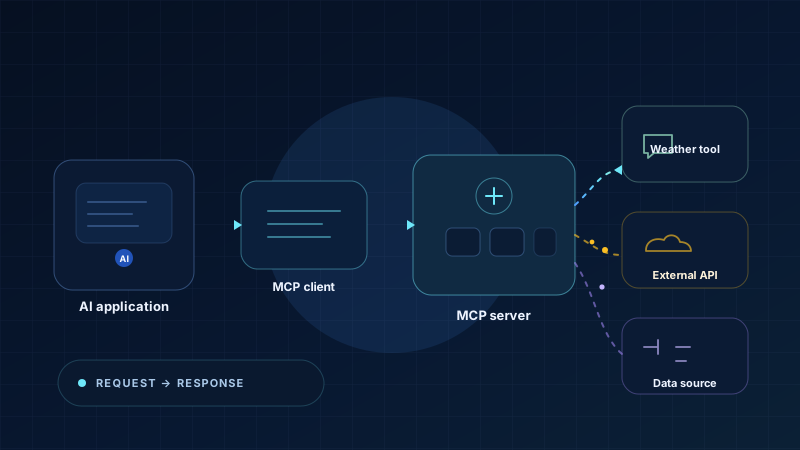
Apps rarely work alone. A shopping app may need to know where an order is. A maps app may need current traffic. A payment app may need to receive a result from a bank. Applications, APIs and AI tools work together through a series of requests and responses.
Two ideas matter here. An API is a defined way for one piece of software to ask another for information or action. MCP is a shared approach that lets compatible AI applications connect to approved tools and information. They are related, but they are not the same.
A simple flow
In the simplest case, a person uses an application, the application makes a request through an API or an AI connection, a service does the work and a result comes back. The result may be a delivery date, a payment confirmation, a map route or an answer from a document.
What an API is
API stands for application programming interface. It is a defined way for one piece of software to ask another for information or an action. It is not just a web address. An API has a contract: what you may ask, what you must send, what comes back and what an error means.
Suppose a shopping app wants to show “out for delivery”. It calls an order service with an order number. The service checks who is asking and whether that order belongs to them, then returns a status. The shopping app does not need access to the shop's entire database. It only needs the one answer it is allowed to see.
APIs are used by ordinary software as well as AI systems. A weather service, a payment provider, a map and a bank may each offer an API with its own rules. Good documentation explains the contract. Good security checks the caller before returning private information.
What MCP is
MCP stands for Model Context Protocol. It is a shared way for compatible AI applications to connect to external tools and information sources. Instead of every AI app inventing a different connector for every service, MCP defines a common conversation.
The main parts are:
AI application or host
The application a person interacts with. It decides what the person sees and which connections are available.
MCP client
The part inside the application that manages a connection to an MCP server.
MCP server
The component that offers approved tools or information. It should enforce its own access rules.
Tools and resources
The actions that can be requested and the information that can be made available.
A tool might look up a record or perform an approved action. A resource might be a document or a piece of reference information. The exact set depends on what the server is configured to offer.
A typical MCP interaction
The map below is interactive. Select a part to read what it does, or press Start to follow a request to an approved tool and back again. It is an illustration, not a live connection.
Person → AI app → MCP client → MCP server → approved tool
Five parts, one request path, and a response that returns the same way.
Select a component to read about it, or press Start to follow a request through the flow.
Person
A person asks for something in the AI application. They may not know whether the answer comes from the model, a connected tool or a document.
This diagram is illustrative. It does not connect to a live service. A real deployment may add identity, policy, logging and multiple servers.
API vs MCP
The two concepts solve related but different problems. An API is a contract between software. MCP is a common approach for compatible AI applications to discover and use tools or information exposed by MCP servers.
A way for software to communicate
- Defines requests, responses, errors and access rules
- Can connect any kind of software, with or without AI
- The service that owns the data enforces its rules
- An MCP server may use an API internally
A common way for AI tools to connect
- Defines a shared conversation for AI hosts and servers
- Exposes approved tools and information
- Does not replace every API
- Does not decide permissions by itself
Access must be set up and authorised
MCP does not automatically give an AI system unrestricted access to a person's device, accounts or data. A connection has to be configured, and the relevant permissions have to be granted. The server should expose only what it intends to offer.
- A person or administrator should know which connections are enabled.
- Read-only tools should be separate from actions that change or delete something.
- Money, personal information and important actions should need clear confirmation.
- Access should be limited to what the task needs and should be easy to revoke.
- A failed or empty result should be reported honestly, not filled in by the AI.
A protocol can standardise a conversation. It cannot decide whether a particular person should see a record, spend money or change a booking. Those decisions belong in the surrounding system, with clear rules and human approval where needed.
A simple example: checking an order
Suppose a shopping app offers an MCP server with a read-only order lookup tool. A person asks the AI app, “Where is my order?” The AI application uses its MCP client to ask the server. The server checks that the request is allowed, uses the approved tool to look up the order, and returns the status.
The AI app then explains the result to the person. If the lookup fails, it should say that it could not check, rather than inventing a delivery date. Cancelling the order would be a separate action tool and should require explicit confirmation.
This is a hypothetical example. It is not a claim that any real shopping service uses MCP.
What connections do not solve
APIs and MCP can make integrations more consistent, but they do not make the information true, the tool safe or the AI reliable. The service still needs testing, clear errors and access controls. The AI application still needs to check results and know when to stop.
The useful mental model is simple: a connection is a way to have a conversation. Trust comes from who is allowed to speak, what they can do and what happens when something goes wrong.
Key takeaways
- An API is a defined way for one piece of software to request information or an action from another.
- MCP stands for Model Context Protocol. It is a shared way for compatible AI applications to connect to external tools and information sources.
- The main MCP parts are the AI application or host, the MCP client, the MCP server, and the approved tools or resources.
- A request travels to a service or approved tool and the response returns through the connection. Access must be configured and authorised.
- MCP does not replace every API and does not give an AI system unrestricted access to a device, account or data.