
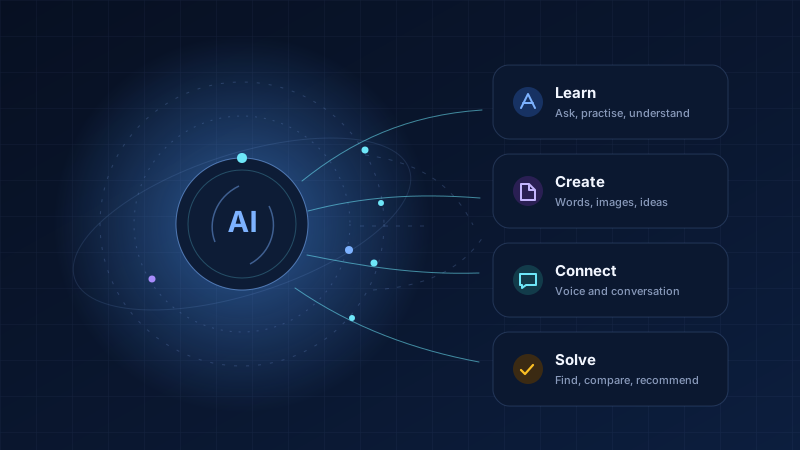
Artificial intelligence, or AI, is a term for computer systems that can do tasks we usually connect with human thinking: recognising a photo, understanding speech, translating text or suggesting a route. It is not one machine and it is not magic. Most AI people use today learns from large numbers of examples and then produces a useful result for a new situation.
AI is already part of ordinary life in India. It may be sorting a photo album, suggesting the next word in a message or helping a bank notice an unusual transaction. You do not need to understand the mathematics to use it well. You do need a realistic idea of what it can and cannot do.
What AI means in simple language
One useful way to think about AI is pattern spotting at scale. A system is shown many examples — pictures, sentences, sounds, clicks or measurements — and learns to recognise a pattern that appears in them. Later, it applies that pattern to something new.
A photo app can learn what a dog usually looks like and then find dogs in your gallery. A voice-typing system can learn the sounds of speech and turn them into words. A language model can learn patterns in text and produce a reply that fits the question. These are different kinds of AI, used for different jobs.
The important point is that the system is calculating a likely answer, not understanding the world in the way a person does. That is why it can be helpful and wrong in the same sentence.
Where you already meet AI
You do not have to open a special “AI app” to use AI. These everyday experiences often depend on it:
- Voice typing and language translation: speech is turned into text, and text may be translated into another language. This can help someone write a message in English, Hindi or another language. Background noise, accents and mixed languages can still reduce accuracy.
- Maps and directions: traffic predictions and route suggestions can use past and current travel data. They are useful, but a road closure or a new one-way street can still catch them out.
- Online shopping: search results, product recommendations and delivery estimates often use patterns in past activity. A recommendation is not a neutral opinion, and it is not a promise that the product is right for you.
- Photo albums: apps may group similar faces, recognise objects or let you search for “train” or “birthday”. Face grouping can involve personal data, so check the app's privacy settings.
- Spam and fraud checks: email filters and payment systems may flag unusual messages or transactions. These systems make mistakes in both directions, so a warning is not proof of fraud and a silent filter is not proof of safety.
- Customer service: a chatbot may answer a common question about a delivery or a bill, then pass the conversation to a person. It should be clear when you are talking to an automated system.
Not every feature described as “AI” uses a large language model. Many are ordinary prediction, ranking or sorting systems. The label does not tell you how the system works or whether it is reliable.
Where it may help in India
AI is being explored in areas where India has large, difficult and varied problems. The possibilities are real, but they are not automatic.
Education: a learning tool can generate practice questions, explain a concept in a simpler way or help a teacher prepare material. It can also produce wrong answers or ignore the syllabus. A teacher or parent still needs to check what a child is learning.
Farming: advisory tools may combine weather, soil and crop information, or answer questions in a local language. Usefulness depends on local data and conditions. Advice that works for one district or crop may not work for another.
Healthcare: AI can help review scans, draft notes or flag patterns for a clinician. It does not replace a doctor's judgment. A wrong or missed finding can be serious, so medical tools need careful testing, clear limits and human oversight.
Small businesses: AI can help draft invoices, answer routine customer messages, translate product descriptions or organise records. It can also make up a tax rule or send an embarrassing reply. Small businesses should keep a person in charge of anything involving money, law or customer trust.
These are possibilities, not promises. A technology that works well in a demonstration may behave differently with poor connectivity, mixed languages or limited local data.
What it does well
AI is often useful when the task involves messy language or images and a reasonable first answer saves time. It can summarise a long document, suggest a draft, translate a first version, group similar complaints or help someone find a starting point. It also works at any hour, which can be helpful for a small team.
These benefits are real but limited. A quick draft still needs reading. A summary still needs checking against the source. A translation still needs someone who knows the language and the context.
Where AI can go wrong
AI is useful partly because it is confident. That is also a problem. A language model can produce a clear, well-written answer that is completely wrong. This is often called a “hallucination”.
- Old or missing information: the system may not know about a recent change, a local rule or a new price.
- Unfair patterns: if the examples used for training under-represent a language, accent, region or group, the results may be worse for those people.
- Privacy: anything you type into a public AI tool may be stored or used under that company's terms. Avoid sharing account numbers, passwords, medical reports or other sensitive details unless you understand the policy.
- Fake content: AI can generate realistic images, voices and messages. Seeing or hearing something is no longer proof that it happened.
- Automation bias: people tend to trust a machine's answer once it appears on a screen. A polished interface can make a weak result feel more reliable than it is.
For money, health, legal matters, travel documents or safety, confirm important information with a reliable human or official source. An AI answer can help you prepare a question. It should not be the only reason for an important decision.
What is real today, and what may come next
Today, AI is good at producing likely text, recognising common patterns and helping with routine digital work. It is less reliable when it must know a local fact, follow a strict rule, explain its reasoning or take responsibility for a serious decision.
In the coming years, tools may become better at Indian languages, images, voice and messy real-world information. Some tasks will become faster. But improvements in one area do not remove the possibility of mistakes in another. New rules, better testing and digital literacy will matter as much as new models.
How to use AI sensibly
You do not need to become an AI expert. A few habits go a long way:
Start with the purpose
Decide what you need: a draft, a summary, a translation, a set of options or a quick explanation. Ask for that, not just “tell me everything”.
Ask where the answer came from
If the tool can cite sources, check them. If it cannot, treat factual claims with extra caution.
Check the important parts
Use an official website, a doctor, a teacher, a lawyer or a trusted colleague for anything that matters.
Protect your privacy
Do not share more personal information than the task needs. Read the privacy settings before uploading documents or photos.
Keep responsibility human
AI can help you prepare. A person should still make the final decision and be accountable for it.
Notice over-reliance
If you stop checking because the answers usually look right, that is the moment to slow down.
The useful question is not “Will AI replace people?” It is “Which parts of this task can it support, and where must a person stay responsible?” That question applies to a student, a shopkeeper, a doctor and a software developer alike.
Key takeaways
- AI is a group of computer techniques that spot patterns and produce useful results from examples. It is not human understanding.
- People already meet AI in voice typing, translation, maps, shopping recommendations, photo albums and customer service.
- AI may help in education, farming, healthcare and small businesses, but results need local context and human checking.
- AI can be confidently wrong, reflect unfair patterns and expose private information. Important decisions should not rest on one AI answer.
- Sensible use means a clear purpose, checking important facts, protecting privacy and keeping human responsibility.